Mattress Materials & Sleep Guides
How to Evaluate an Organic Mattress: Materials, Certifications, and Trade-Offs
“Organic mattress” sounds like a description with its own tidy conclusion: natural materials, a cleaner bedroom, perhaps a more virtuous night’s sleep. In practice, it is a starting point, not a verdict. The useful questions are more specific. Which materials are organic? What sits next to the sleeper, and what lies deeper in the mattress? Which standards have been verified, and what do they actually cover? And, after the labels have had their say, will the mattress suit the person who has to sleep on it?
Published October 21, 2026
Begin with the mattress, not the adjective
There is a reason “organic” has become a powerful word in the bedding aisle. Mattresses are large, close to the body, and used for a substantial part of every day. Buyers may reasonably want to know what their bed is made from, how its materials were produced, and whether its manufacture relies on treatments they would rather avoid. Those are worthwhile questions. The word on a label, however, can make the answers seem simpler than they are.
An organic mattress is not necessarily made entirely of certified organic materials. The term may refer to particular fibers, such as cotton or wool, while the mattress also contains other materials. Natural latex, for example, comes from rubber-tree sap, but “natural” does not automatically mean “certified organic.” Nor does it settle questions about processing, additives, or the finished product. A mattress can be made with some organically grown components without every part of the finished bed meeting one all-encompassing organic standard.
So treat the phrase as an invitation to inspect the construction. Ask for a component list that names the materials, describes where they appear, and identifies any applicable certification. A transparent maker should be able to distinguish the cover from the filling, the comfort layers from the support core, and the materials with third-party credentials from those without them. If the product information offers only a pleasing collection of words—natural, clean, green, pure—it has not yet told you enough.
The materials, and the jobs they do
A mattress is a small architecture of competing needs. It must support weight, allow pressure to distribute, manage warmth and moisture, and retain its shape through repeated use. Materials contribute differently to those tasks. No single fiber or foam can be expected to perform every one of them equally well.
Natural latex: buoyant, responsive, and not one thing
Latex used in mattresses is commonly made from rubber-tree sap, processed into a resilient foam. Its characteristic feel is often described as buoyant: the surface yields, but tends to push back more quickly than slow-response memory foam. That responsiveness can make it easier to move or change position, while the material’s springiness can provide a distinct sense of support. Whether that feels comfortable is personal, not a property a product description can decide for you.
“Natural latex” can describe the source of the material, but it does not by itself establish that the latex was organically produced or that the entire mattress is organic. Ask whether the latex is natural, synthetic, or a blend; whether it is Dunlop- or Talalay-produced; and which certification, if any, applies to the latex itself. Different manufacturing processes can create differences in density and feel, but labels and brand conventions are not substitutes for a clear specification sheet.
Latex is also a material with practical considerations. Some people value its durability and resilient feel; others dislike the sensation or find the mattress too firm, too springy, or too heavy to handle easily. Natural latex may have a noticeable odor when new. If latex sensitivity is a concern, discuss the specific product and relevant exposure with a qualified health professional rather than assuming that “natural” means appropriate for everyone.
Wool: a layer with several functions
Wool can appear as a filling, a quilted comfort layer, or a component of the mattress’s fire-barrier system. Its fibers can absorb moisture vapor and help moderate the feel of the sleep surface. The amount, placement, and density of the wool matter: a thin layer in the cover will not behave like a deep wool comfort package. Wool is an animal-derived material, so questions about farming practices, processing, and certification may matter to buyers for environmental, ethical, or personal reasons.
It is worth separating wool’s natural properties from broad claims about performance. A wool layer does not guarantee that a mattress will keep every sleeper cool, prevent allergies, or stay comfortable in every climate. Bedding, room temperature, humidity, sleepwear, and individual heat sensitivity all contribute to the experience. Ask how much wool is used, where it is placed, and how the manufacturer recommends caring for the mattress.
Cotton: close to the skin, but not always the whole story
Cotton commonly appears in ticking—the fabric cover—and may also be used in batting or quilting. It can provide a familiar, breathable textile surface and may be produced under organic agricultural standards. Yet the words “cotton cover” do not tell you whether the cotton is organic, whether it is blended with other fibers, or whether the certification covers the finished textile or only its fiber content. Ask for the exact material description rather than inferring the answer from a natural-looking fabric or a reassuring color palette.
Cotton’s role in the finished mattress is also limited by construction. A cotton cover cannot transform a synthetic-foam core into an all-organic mattress. At the same time, an organic cotton cover can still be a meaningful feature for someone who is looking specifically for a certified textile surface. The distinction is not a trick; it is simply a reminder to identify the scope of a claim.
Other components deserve a place on the list
Springs, adhesives, thread, flame barriers, edge supports, and fabric blends may all be part of a mattress. Some are essential to its construction; others vary by design. Their presence does not, by itself, make a mattress unacceptable. It does mean that a material claim should be read in context. If the manufacturer calls a mattress organic, request a full materials breakdown and ask how the claim relates to the entire product, rather than only the most marketable layer.
Certifications: useful boundaries, not magic words
Third-party certifications can make material claims easier to assess. Their value lies in defining what was inspected and against which standard. Their limit lies in that same definition: a certification addresses particular criteria, materials, or stages of production. It is not a universal guarantee of comfort, durability, environmental impact, or health outcomes.
For organic textiles, a standard such as the Global Organic Textile Standard (GOTS) may be relevant. It includes requirements concerning organic fiber content and aspects of textile processing, subject to its certification rules and product category. The precise claim matters. A certified fabric component is not necessarily the same thing as a fully certified finished mattress. Look for the certification’s scope, the product or component covered, and the certifier’s details.
For latex, the Global Organic Latex Standard (GOLS) is one certification buyers may encounter. It concerns organic latex and includes requirements related to processing and supply-chain oversight. Again, the presence of a logo should prompt a careful question: does it apply to the latex core in this specific mattress, and can the manufacturer provide supporting documentation? Do not assume that a certification for one component extends to every material in the bed.
Other standards may speak to emissions, chemical content, or product testing rather than organic agriculture. These can address different concerns. A low-emissions certification, for instance, is not equivalent to an organic certification; a materials-content standard does not prove that a mattress is free of every chemical; and a general safety standard is not a comfort rating. Read the named standard and its scope, not only the seal’s graphic appearance.
Certification programs can change, and their exact requirements should be checked with the issuing organization. If a retailer or manufacturer makes a claim, ask for the current certificate or a verifiable certificate number, along with the name of the certified product or component. A confident answer should be specific. “We use certified materials” is less informative than “the cotton cover is certified under this named standard, and the certificate applies to this product line.”
What a product example can—and cannot—tell you
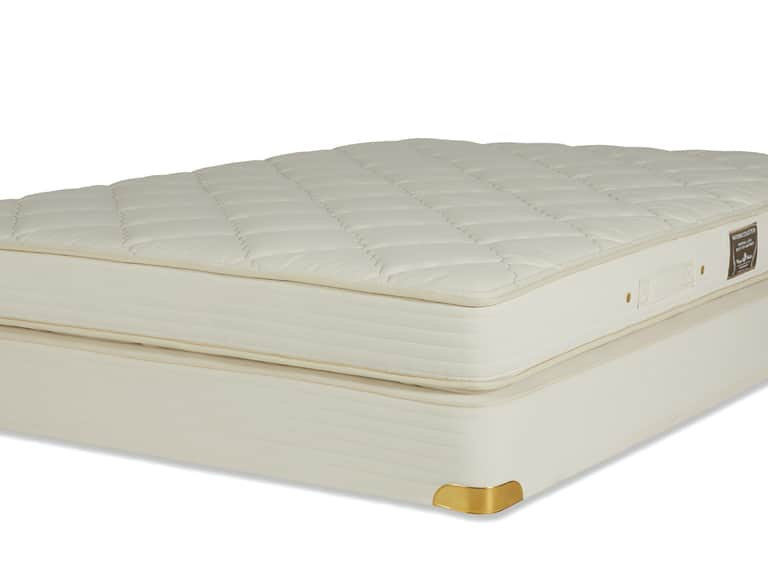
Consider a mattress such as the Royal-Pedic Natural Latex Quilt-Top Mattress with canvas ticking. Its description identifies an eight-inch latex core, French wool, and a cotton outer fabric, and presents the wool as part of the mattress’s temperature and flame-barrier design. Those details make the construction easier to picture. They do not, on their own, establish that the latex, wool, cotton, or complete mattress is certified organic. A buyer who needs that assurance should ask which components carry which certifications and request the supporting documentation.
Likewise, a natural-fiber mattress may use wool and cotton in a carefully layered construction without being described as wholly organic. The Vispring Regal Superb, for example, is described as using Shetland wool, cotton, South American horsetail, British fleece wool, and pocket springs. That is a description of natural and other specified components, not a substitute for evidence of organic certification. The distinction is useful: material transparency and organic status are related questions, but they are not interchangeable ones.
These examples also show why component-level reading is more revealing than a headline. A detailed description can explain how wool is placed, how the support system is built, and how the mattress is intended to feel. It still cannot tell every sleeper whether the surface will suit their body, sleeping position, or temperature preferences. Construction is evidence about design; comfort remains an experience to test.
Comfort is a trade-off, not a certification
Organic or natural materials do not arrive with a guaranteed firmness. A mattress’s feel depends on its full design: the thickness and density of each layer, the spring system or foam core, the quilting, and the base beneath it. Two beds with similar ingredient lists can feel markedly different. A latex core with a thin wool quilt may feel unlike a latex core under a thick, plush comfort package.
Start with the way you sleep and the support you find comfortable. Side sleepers often pay attention to cushioning around the shoulder and hip; back and stomach sleepers may prefer a surface that keeps them from sinking too deeply. These are starting points, not rules. Body shape, weight distribution, pain history, and personal preference complicate any neat chart. If possible, test the mattress in a realistic position and ask about the trial period, return conditions, and fees before buying.
Sharing a bed introduces another set of compromises. A responsive latex surface may appeal to someone who wants to move easily, while another sleeper may prefer a different degree of contouring. A spring system may reduce the transfer of movement to some extent, but performance depends on design. Ask about the specific mattress rather than treating the material name as a prediction.
Temperature is similarly individual. Wool and cotton are often chosen for their moisture-management and breathable qualities; latex construction and the layers around it also influence how a mattress feels. Yet no fiber can cancel out a warm room, a heavy duvet, or a sleeper who naturally sleeps hot. Think about the entire sleep environment, including sheets, mattress protectors, pajamas, humidity, and airflow.
Care, durability, and the less glamorous questions
A mattress is a long-term household purchase, which makes maintenance part of the evaluation rather than an afterthought. Some models are designed to be rotated; others should not be flipped because their layers are arranged in a particular order. Follow the maker’s instructions. Rotating or flipping a mattress against its design can affect comfort and may complicate a warranty claim.
Check whether the cover is removable, whether it is washable, and what the manufacturer recommends after spills or stains. “Natural” does not mean “washable,” and a removable cover is not necessarily machine washable. Wool and latex components may require specific handling. Using an appropriate mattress protector can help guard against moisture and everyday wear, but the protector itself may change the surface feel or temperature.
Durability is influenced by materials, construction, use, and care. A warranty may cover defined manufacturing defects while excluding ordinary softening, comfort preference, or damage caused by an unsuitable base. Read the warranty terms, required support conditions, and procedures for claims. Also ask about the recommended foundation: a mattress placed on an incompatible base may not perform as intended, regardless of its materials or certifications.
Finally, consider the practicalities of delivery and replacement. Natural latex mattresses can be heavy; some models arrive compressed, while others require room-of-choice delivery. Ask about setup, old-mattress removal, return transport, and whether the trial policy has a minimum-use period or a pickup charge. A product can be beautifully specified and still be a poor purchase if the logistics are unclear.
A measured way to assess environmental claims
Choosing organic materials may align with a preference for agricultural practices or textile standards, but the word “organic” does not automatically summarize a product’s full environmental footprint. Growing, processing, transporting, assembling, packaging, and disposing of a mattress all have impacts. A label focused on fiber production cannot, by itself, account for the entire life cycle.
Ask whether the company provides information about sourcing, manufacturing location, repair or recycling options, and product lifespan. Compare like with like: an independently verified claim about one component is more useful than a broad, unqualified promise about being “eco-friendly.” No mattress needs to solve every environmental problem to be a reasonable choice. The aim is to understand what the evidence supports and where information is missing.
Also be wary of the idea that “chemical-free” is a precise technical description. All materials consist of chemicals, including natural ones. What buyers usually want to know is whether a product contains particular substances, how emissions are assessed, or what treatments are used. Ask that question directly and look for specific disclosures or relevant testing, rather than relying on a phrase that may mean different things to different sellers.
Questions to ask before you buy
A short list can keep a mattress search from dissolving into a fog of attractive adjectives. Bring these questions to the retailer or manufacturer and ask for answers in writing when the details are important to your decision:
- What are all the materials in the mattress, including the cover, comfort layers, support core, adhesives, and fire barrier?
- Which components are certified organic, and which named standard applies to each one?
- Does the certificate apply to this specific product, or only to a material, supplier, or product range?
- Is the latex natural, synthetic, or blended, and what information is available about its processing?
- How much wool or cotton is used, and where are those fibers located in the construction?
- What is the mattress’s firmness, and can I try it under the conditions described in the trial policy?
- What kind of base does the mattress require, and does the warranty specify support requirements?
- How should it be cleaned, rotated, or otherwise maintained, and can any cover be removed or washed?
- What are the return, delivery, removal, and warranty terms, including fees and exclusions?
A seller does not need to make the bed sound perfect. In fact, a useful answer will usually include limitations: a cover that cannot be washed, a material that may not suit every sleeper, or a certification that applies to only one layer. Specificity is often a better sign of reliability than enthusiasm.
The sensible conclusion
An organic mattress may be a thoughtful choice for someone who values certified fibers, transparent sourcing, or a particular combination of materials. It is not automatically the most comfortable mattress, the most durable one, or the right option for every budget and bedroom. Natural latex, wool, and cotton each have distinct roles and trade-offs; the finished feel depends on how those materials are assembled.
Evaluate the bed in two passes. First, establish what it is made of: read the component list, verify certification scope, and separate organic claims from broader claims about natural materials or emissions. Then consider how it will work in ordinary life: support, temperature, care, delivery, trial terms, and the base beneath it. If both sets of answers are clear, the choice is no longer a matter of trusting a grand label. It becomes a practical decision, made with enough information to sleep on.
At a glance
- Organic is a specific claim: confirm which materials and product components are covered.
- Natural is not the same as certified organic: source, processing, and certification are separate questions.
- Materials affect feel, but do not determine it alone: construction, firmness, and the bed base matter.
- Certifications have defined scopes: verify the named standard and the certificate’s applicability.
- Comfort and care are practical tests: review trial policies, maintenance instructions, warranty terms, and delivery arrangements.